


Key Ingredients in Pheromone Products: Their Impact on Personal Attractiveness

Meetings at clubs or in the workplace often raise the question of how to be more memorable and attractive among others. In search of new ways to build a stronger presence, more and more young people in Central Europe are turning to pheromone perfumes. Scientific data shows that chemical signaling compounds can subtly enhance perceptions and improve social interactions. This article reveals how pheromones work and how to use them most effectively.
Table of Contents
- What are pheromone ingredients and how do they work
- Types of pheromones in perfumery and their role
- Synthetic versus natural pheromones: advantages and disadvantages
- Key excipients and their function
- Risks, allergies, and safe use in the EU
- Legislation and labeling of pheromone products in Central Europe
Key Takeaways
| Point | Details |
|---|---|
| Pheromones | Pheromones are chemical signals that influence behavior and social dynamics between individuals. |
| Types of Pheromones | Various pheromones with unique effects are used in perfumery, influencing attractiveness and social interactions. |
| Safety | It is important to be aware of possible allergies and side effects when using pheromone products. |
| Pheromone Production | The choice between synthetic and natural pheromones depends on individual preferences and desired effects. |
What are pheromone ingredients and how do they work
Pheromones are chemical signaling compounds that play an extremely important role in communication between organisms. According to scientific research, they are specific chemical substances released outside the body to transmit information between individuals of the same biological species.
In humans, pheromone ingredients function as:**
- Invisible chemical signals
- Communication carriers
- Factors influencing hormonal balance
- Potential activators of behavioral responses
The main characteristic of pheromones is their ability to induce involuntary reactions in the perceiving organism. Chemical studies show that they are released through various body fluids such as sweat, urine, and saliva, and can cause immediate hormonal and behavioral changes.
Key mechanisms of pheromone action include direct influence on the nervous system and hypothalamus, which can cause:**
- Mood changes
- Activation of sexual interest
- Increased attention
- Stimulation of emotional responses
In humans, however, unlike some animal species, the effect of pheromones is more subtle and less direct. They act more as subtle cues than as powerful biological command signals.
Pro tip: Although pheromones have a scientific explanation, their effectiveness can vary greatly depending on individual biological characteristics.
Types of pheromones in perfumery and their role
Pheromone products in modern perfumery are divided into several main categories, each with unique characteristics and purposes. Chemical studies show that they are specific compounds without a discernible scent that subtly influence human perception.
The main types of pheromones in perfumery include:**
Summary table of the main types of pheromones in perfumery and their effects:
| Pheromone Type | Main Effect | Typical Gender of Action |
|---|---|---|
| Androstenone | Stimulates dominance | Predominantly in men |
| Androstenol | Enhances social acceptance | Both genders |
| Estratetraenol | Increases attractiveness | Predominantly in women |
| Copulins | Stimulates sexual attraction | Female pheromone |
- Androstenone - a male pheromone associated with dominance
- Androstenol - a pheromone that induces socially friendly behavior
- Estratetraenol - a female pheromone with high attractiveness
- Copulins - a pheromone that stimulates sexual interest
These pheromone ingredients are produced by two main methods:
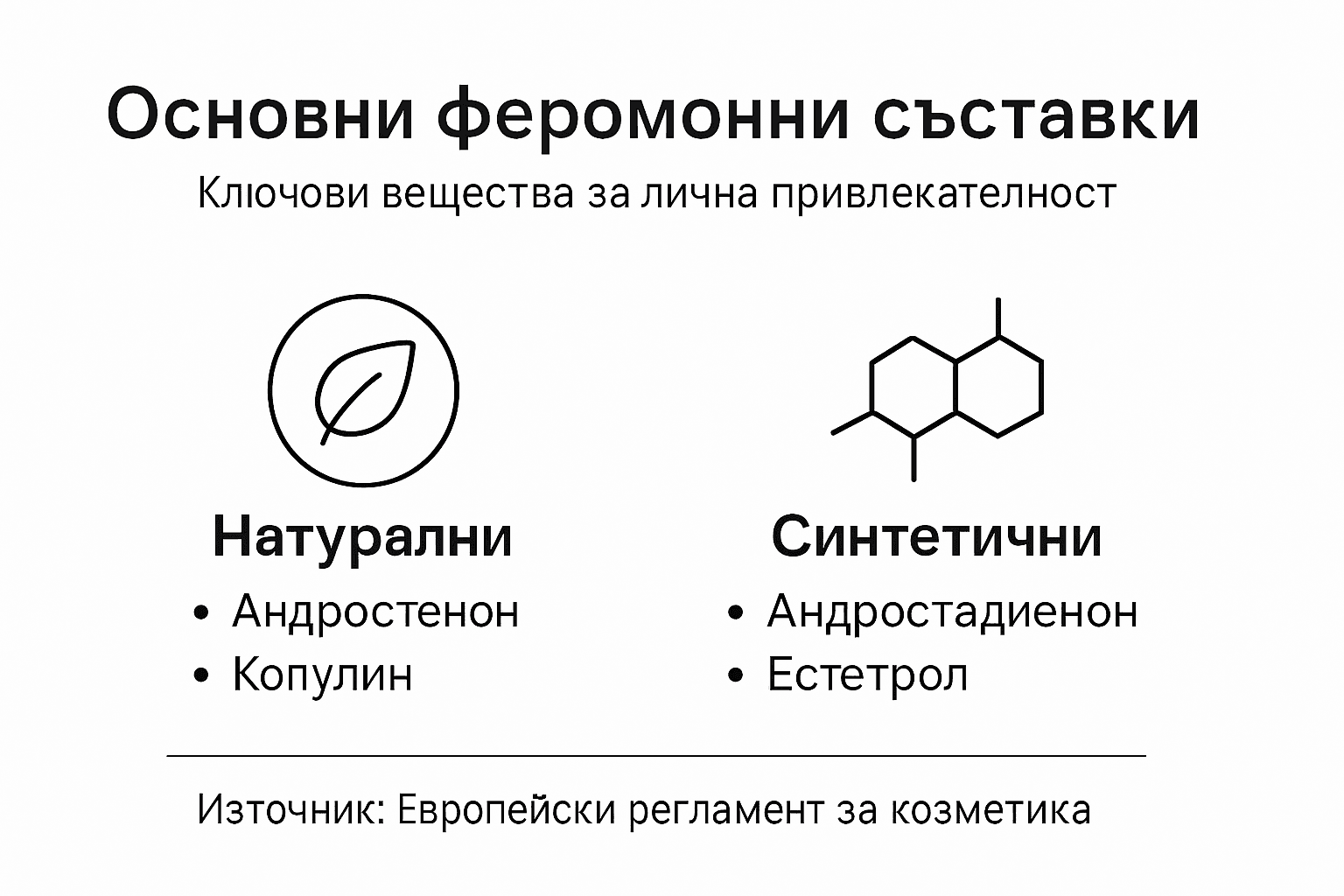
- Natural extraction from human biological fluids
- Synthetic production in laboratory conditions
When creating pheromone perfumes, specialists combine different concentrations to achieve maximum effect on the subconscious. It is important to note that their impact varies depending on the individual biological characteristics of each person.

When using pheromone products, it should be kept in mind that they do not act as a magical solution, but rather as subtle communication signals that slightly increase the possibilities for social and intimate interaction.
Pro tip: Experiment with different concentrations and combinations to find the pheromone product that is most suitable for your body.
Synthetic vs. Natural Pheromones: Advantages and Disadvantages
Synthetic and natural pheromones represent two main approaches in modern perfumery, each with unique characteristics. Research shows different advantages and limitations in their production and application.
Advantages of synthetic pheromones:**
- High product stability
- Controlled production
- Lower cost
- Ingredient uniformity
- Easy scalability of production
Advantages of natural pheromones:**
- More complex and rich aromatic profile
- Authenticity of the biological signal
- Closer to natural human pheromones
- Potentially stronger impact
- Higher biological compatibility
The main difference between the two types lies in their production and chemical composition. Synthetic pheromones are created entirely in laboratory conditions, while natural ones are extracted through specific methods from human biological fluids under extremely strict research protocols.
When choosing between synthetic and natural pheromones, individual biological characteristics, desired effect, and personal preferences of the consumer should be taken into account.
Here is a comparison between synthetic and natural pheromones:
| Characteristic | Synthetic Pheromones | Natural Pheromones |
|---|---|---|
| Method of Production | Laboratory synthesis | Isolation from biological fluids |
| Consistency of Content | High | Varies by source |
| Aroma Diversity | Limited | Rich and complex |
| End Product Price | Usually lower | Higher due to extraction |
| Allergy Probability | More easily controllable | Potentially greater |
Pro tip: Consult an expert who can recommend the most suitable type of pheromone product according to your individual characteristics.
Key excipients and their function
Excipients in perfumes play a critical role in the final quality and effectiveness of the product. Technological research shows that they are not just additional ingredients, but determine the stability, safety, and functionality of aromatic compositions.
The main categories of excipients include:**
- Stabilizers - prevent ingredient degradation
- Preservatives - extend shelf life
- UV absorbers - protect from solar degradation
- Solvents - ensure a homogeneous mixture
- Carriers - evenly distribute aromatic molecules
In the production of pheromone products, specialists apply strict criteria for selecting excipients, taking into account:**
- Biological compatibility
- Hypoallergenic properties
- Formula stability
- Even distribution
- Potential for longevity
Scientific studies warn that some excipients can cause skin irritation or allergic reactions, necessitating an extremely precise approach to their use.
Pro tip: Always check the perfume ingredients and if you have sensitive skin, consult a dermatologist before use.
Risks, allergies and safe use in the EU
European legislation places extremely strict requirements on the production of perfumes and pheromone products. The product safety system guarantees maximum protection for consumers from potential health risks.
The most common risks associated with the use of pheromone products include:**
- Skin allergic reactions
- Contact dermatitis
- Hypersensitivity
- Skin irritation
- Possible hormonal disturbances
When creating products in the European Union, manufacturers must comply with the following mandatory requirements:**
- Full declaration of ingredients
- Allergen testing
- Maximum permissible concentrations
- Warning labels
- Traceability of the production chain
The Cosmetic Products Regulation introduces extremely restrictive safety rules, which include detailed requirements for ingredients, testing, and labeling of each product. The main goal is maximum protection of consumer health.
Pro tip: Before using a new perfume, always perform an allergy test on a small area of skin and wait 24 hours.
Legislation and labeling of pheromone products in Central Europe
European legislation for perfume and pheromone products is extremely precise and strictly regulated. Production is subject to detailed rules that guarantee maximum safety for consumers.
Key requirements for manufacturers include:**
- Full documentation for each product
- Safety dossier
- Responsible person for production
- Detailed ingredient labeling
- Compliance with concentration norms
Mandatory labeling elements are:**
- Manufacturer's name
- Full list of ingredients
- Net quantity
- Storage conditions
- Date of manufacture and expiration date
The latest regulations from 2023 introduce additional requirements for the labeling of fragrance allergens, obliging manufacturers to indicate 24 specific allergens for full transparency and protection of consumer health.
Pro tip: When purchasing a pheromone product, always check the full list of ingredients and pay attention to potential allergens.
Enhance your personal attractiveness with Pheromante® pheromone fragrances
In this article, we've learned how important the key ingredients in pheromone products are for boosting your self-confidence and social charm. If you're looking for a way to enhance your natural attractiveness and leave a lasting impression with the subtle chemical signals of pheromones, now is the time to try something different. The quality and correct combination of pheromone components are important, as is the convenience of trusting proven products with guaranteed effectiveness.
Discover our Pheromante® Collections | Long-lasting and Magnetic Fragrances, which combine the best of science and perfumery mysticism. Each fragrance is carefully developed to emphasize your individuality and subconsciously influence those around you. Enter the world of confidence and charisma with pheromante.com products and take the first step towards social success today.
Frequently Asked Questions
What are pheromones and what is their role?
Pheromones are chemical signaling compounds that transmit information between individuals of the same species. They can influence mood, social interaction, and sexual interest.
What are the main types of pheromones used in perfumery?
The main types of pheromones in perfumery include androstenone, androstenol, estratetraenol, and copulins, each of which has a unique effect on personal attractiveness.
How do I use pheromone products for maximum effect?
It is recommended to experiment with different concentrations and combinations of pheromone products to find the most suitable option for your body and personal style.
What are the risks of using pheromone products?
Some of the risks include skin allergic reactions and irritation. It is important to perform a preliminary allergy test and follow safe use instructions.