


How to Choose a Perfume That Expresses Your Identity

TL;DR:
- Choosing a perfume should be systematic and tailored to skin type and wearing context. Proper testing requires limiting to 3-5 fragrances and patiently waiting for the dry-down when evaluating. Building a small wardrobe with different concentrations and layering creates a unique signature that reflects one's personality.
Choosing a perfume seems simple until you stand before a shelf with two hundred bottles and realize you have no system. Most people buy hastily, misled by a first impression or a beautiful package, and a week later realize the scent doesn't suit them. Perfume isn't just an accessory — it's an invisible signature that others perceive before they even hear your voice. This article gives you a concrete methodology: how to prepare, how to test correctly, and how to build a personal scent that truly reflects who you are.
Contents
- Key Factors for Preparation Before Choosing
- How to Properly Test Perfume — Step by Step
- Choosing Concentration and Suitable Fragrance According to Occasion and Environment
- Small "Wardrobe" and Layering: How to Be Unique and Flexible
- My Approach: How I Chose a Perfume That Changes Communication
- Discover More Fragrances and Personal Solutions
- Frequently Asked Questions
Key Takeaways
| Point | Details |
|---|---|
| Limit your choices | Select only 3–5 main fragrances and test them carefully on your skin. |
| Wait for the dry-down | Evaluate the scent after at least 30–60 minutes, when the notes have fully developed. |
| Choose concentration based on context | Select EDT, EDP, or Parfum according to the environment and occasion of use. |
| Create a small wardrobe | A flexible fragrance collection allows you to be unique and adaptable in any situation. |
| Combine scents wisely | Layering and experimenting lead to a personalized and meaningful fragrance. |
Key Factors for Preparation Before Choosing
Before entering a store or ordering online, you need to know three things about yourself: your skin type, your personal style, and the context in which you will wear the fragrance. Oily skin intensifies and holds the scent longer, while dry skin "absorbs" it faster. This is not a minor detail — it's a difference of hours in longevity.
Limit your choice to a maximum of 3 to 5 fragrances per visit. Olfactory fatigue sets in quickly, and after the fifth scent, you can no longer perceive differences. Proper testing begins by limiting the number of fragrances and systematically comparing them after a certain time, not by haphazardly spraying everything.
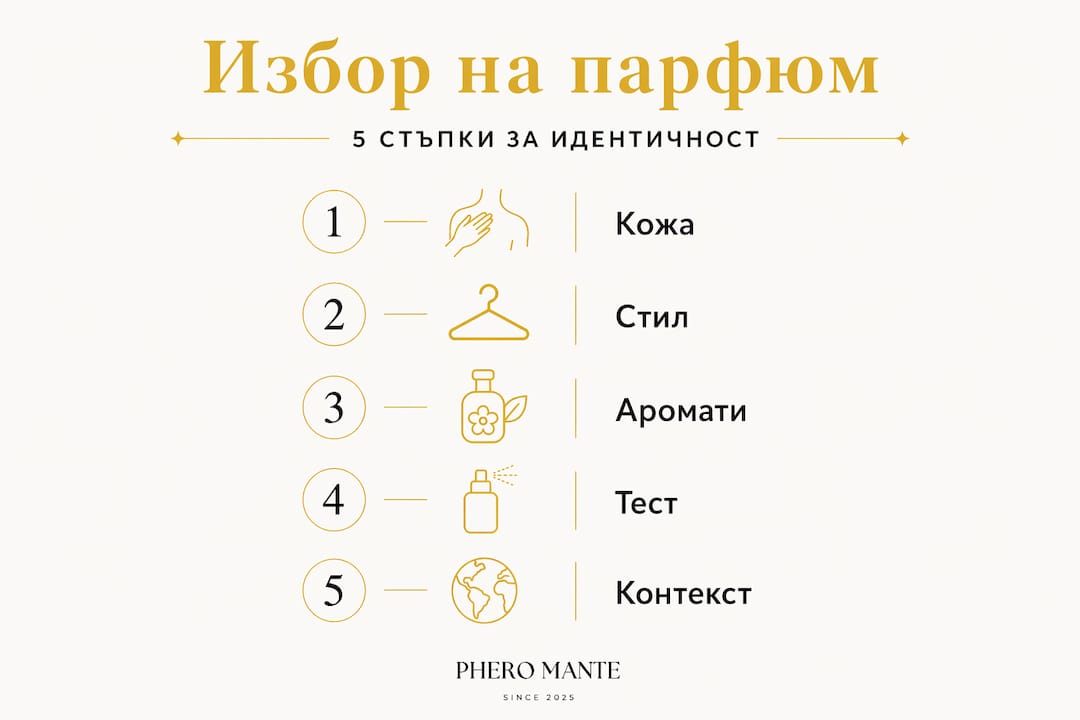
Prepare your skin before testing. Avoid strong perfumes, lotions, and scented creams for at least an hour before testing. Skin care before applying perfume directly affects how the scent develops and how accurate an impression you will get.
Also consider the structure of your personal fragrance wardrobe. You don't need one "universal" scent — you need two or three, each for a different situation. See our perfume selection checklist to structure the process before you even open a bottle.
| Criterion | What to do |
|---|---|
| Skin type | Oily: expect stronger projection; dry: apply neutral lotion |
| Context | Work, meeting, social environment — different needs |
| Number of scents to test | Maximum 3 to 5 per visit |
| Preparation | No strong scented creams or lotions |
Professional tip: Carry a small vial of neutral coffee beans with you. Smelling coffee between tests "resets" your sense of smell and reduces fatigue.
How to Properly Test Perfume — Step by Step
Testing perfume is an art that most people miss. Here's how to do it correctly:
- Start with a blotter. Spray the paper strip and wait 30 seconds. This gives you a rough idea of the scent's structure and helps you create a preliminary shortlist.
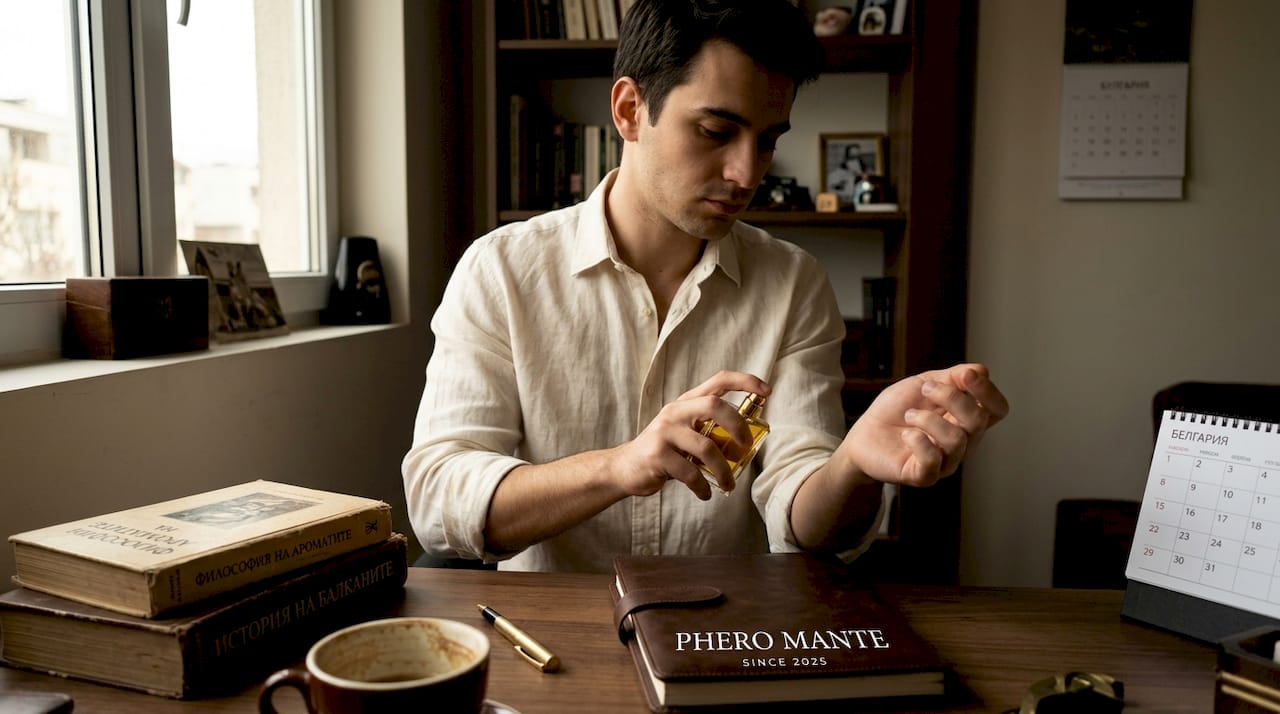
- Apply to a pulse point. The wrist, inner elbow, and neck are the best places. Pulse points emit warmth, which activates the scent.
- Do not rub. Rubbing destroys the molecules of the top notes and distorts the perception.
- Wait at least 30 to 60 minutes. Don't decide on the first impression — top notes dominate only in the first few minutes and do not reflect the true character of the fragrance.
- Evaluate the dry-down. This is the moment when the scent "settles" on the skin and reveals the base notes — the warm, deep, mysterious layers.
"Only on paper" is incomplete: blotters help for a short shortlist, but the actual behavior depends entirely on skin chemistry.
The three phases of each fragrance have different durations and characteristics:
| Phase | Timeframe | What you perceive |
|---|---|---|
| Top notes | 0 to 5 minutes | Alcohol, freshness, citrus |
| Heart notes | 15 to 30 minutes | Floral, spices, main character |
| Base notes | 1 hour and more | Woods, musk, resins, warmth |
Understanding these phases is the difference between buying a scent you like in the store and a scent you love an hour later. Read more about the etiquette of choosing to know how to behave and what to ask when testing.
Professional tip: Test a maximum of two fragrances on your skin simultaneously — one on the left wrist, the other on the right. More than two create confusion, and you cannot evaluate any properly.
Choosing Concentration and Suitable Fragrance According to Occasion and Environment
The concentration of a perfume determines not only its longevity but also the "strength" of its projection — how far others perceive your scent. The difference between EDT, EDP, and Parfum is fundamental for an informed choice.
- EDT (Eau de Toilette): Contains 5 to 15% fragrance oil. Light, fresh, ideal for warm days and daytime use. Longevity around 3 to 5 hours. Perfect for the office and everyday life.
- EDP (Eau de Parfum): Contains 15 to 20% fragrance oil. Balanced, versatile, suitable for almost any situation. Longevity around 5 to 8 hours.
- Parfum (Extrait): Contains 20 to 40% fragrance oil. Intense, deep, designed for evening and cold weather. Longevity 8 to 12 or more hours. Apply sparingly.
The choice of concentration should follow the scenario. For a work environment, EDT or a light EDP are essential — you respect the space of others. For a romantic encounter or an evening event, EDP or Parfum add that provocative dimension that makes a difference. Also explore men's fragrances and concentrations for additional comparison reference.
Learn more about the impact of perfume on psychology and social interactions — a fragrance doesn't just smell good, it sends signals.
Key fact: Studies show that people who wear a fragrance appropriate to the context are perceived as more confident and attentive to details than those who wear a "universal" fragrance everywhere.
Small "Wardrobe" and Layering: How to Be Unique and Flexible
One fragrance cannot tell your whole story. That's why building a small perfume wardrobe is the strategy of people who understand identity and style.
We recommend starting with three main fragrances:
- Daytime fragrance: Fresh, light, unobtrusive. For work, meetings with friends, everyday life.
- Evening or warmer fragrance: Deeper, more sensual, with more character. For dates, dinners, special moments.
- More formal fragrance: Classic, balanced, with authority. For important meetings, formal occasions.
Layering is the next level. Combining two fragrances can create a signature that no one else possesses — literally a unique scent. It works best when one fragrance is "dominant" with a clear character, and the other is "supporting" with a more neutral or complementary base.
Layering is not for every day — it's for moments when you want to leave an indelible impression.
Test the combination for at least 20 to 30 minutes on your skin before deciding if it works. The chemistry between two fragrances on the skin is unpredictable and sometimes surprisingly good. Read about the effect of pheromones and how it interacts with fragrance choice.
Professional tip: Keep a short journal of tested combinations and the reactions of people around you. Subjective feeling and objective feedback together provide the most accurate picture.
My Approach: How I Chose a Perfume That Changes Communication
There was a period when I wore the same fragrance everywhere — to work, to meetings, to formal dinners. I thought a "universal" choice was smart. I was wrong.
The real change came when I started testing fragrances in different dynamics — up close and from a distance, in warm and cold environments, morning and evening. I realized that scent behaves differently depending on the context and how I myself feel. The slow, patient choice is not a waste of time — it's an investment in how you want to be remembered.
The small "perfume flexibility" — having two or three fragrances for different situations — changed the way I communicate. When you choose consciously, you wear the scent with confidence, and that confidence is perceived. People react to it, even when they don't realize why. Explore the difference between perfume and aphrodisiac effect to understand the science behind this dynamic.
The provocative thing about choosing a scent is that it doesn't lie. You can wear whatever you want, but the scent tells a true story about you. Choose it consciously.
Discover More Fragrances and Personal Solutions
You now have the methodology. The next step is to apply it with fragrances created with specific identity and intent.
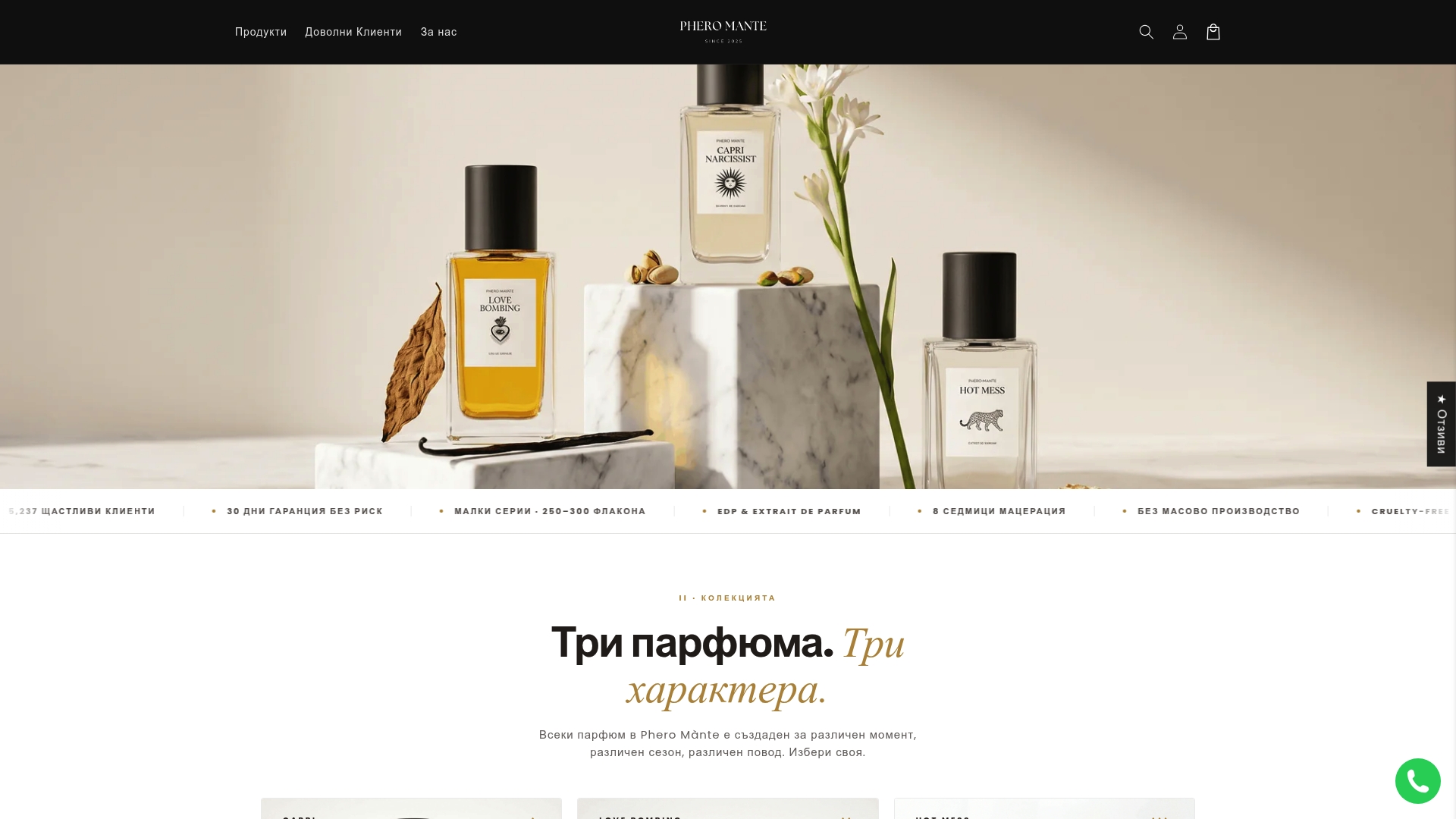
At Pheromante, each fragrance is built around a psychological archetype — not just a pleasant smell, but a tool for self-expression. From Love Bombing with cardamom, tobacco, and caramel to Hot Mess and Capri Narcissist, each composition is produced in Italy and offers true niche perfumery at a fair price. Browse the catalog, find the archetype that resonates with you, and start building your unique signature.
Frequently Asked Questions
How many fragrances are optimal to have in a personal perfume wardrobe?
A minimum of two fragrances is recommended — one for everyday use and one for special occasions. For maximum flexibility and uniqueness, the optimal number is between 3 and 5 fragrances for different scenarios.
What does "dry-down" mean and why is it important?
"Dry-down" is the phase in which the fragrance develops on the skin after the top notes evaporate. Wait at least 30 to 60 minutes after application to assess the true character of the fragrance.
Can I combine different perfumes for more individuality?
Yes, layering works well with careful testing. Test the combination for at least 20 to 30 minutes on your skin before making a final decision.
What perfume concentration is suitable for an office environment?
EDT or a light EDP are most suitable for the office because they are discreet and do not bother others. Strong formulas with high concentration are not suitable for enclosed spaces.
Why does my fragrance behave differently on skin and paper?
Skin has its own pH and temperature, which affects the development and longevity of the fragrance. Blotters show the structure but do not reflect the actual skin reaction and projection.